
Beach
Transcending Sport: “It’s Called Normal” fuels adaptive athletes through new award
August 25, 2024
March 15, 2022
TLAXCALA, Mexico — It’s new. All of it. Nuevo, as the locals say it here in Tlaxcala, Mexico.
It’s a new site for a tournament, the first of the 2022 season, which begins with Wednesday’s qualifier and concludes with Sunday’s finals. In 11 international tournaments held in Mexico, none have been held in Tlaxcala, a state of 1.32 million that’s about a two-hour drive east of Mexico City.
Mostly, however, it’s the first look at the new structure of the international beach volleyball world, aptly named Volleyball World. It’s also the first look at the new Volleyball World streaming service, Volleyball TV, which will be streaming every single match at every single tournament.
In January of 2021, CVC Capital partnered with the FIVB, throwing in a lofty sum of $300 million to, as FIVB President Ary Graca said at the time, create “opportunities that can sustain the development of the sport around the world. In CVC we are confident we have found a partner with the experience, network and capital to support FIVB in its mission to further professionalize the sport for the benefit of fans, players and National Federations.
“Volleyball World will boost our sport’s financial growth and deliver lasting legacies for the whole game. Working in partnership with CVC we will be able to secure volleyball’s future and emerge stronger from the current challenges.â€
We will see. And we will see it here in Tlaxcala, host of the first Challenge event in this new three-tiered system.
The Challenge is the middle of three tiers, sandwiched between the Elite 16 and the Futures. The former features a 16-team main draw, four of which come out of a 16-team qualifier — a concession Volleyball World made after the International Beach Volleyball Players Association banded together and requested it. The latter, too, is a 16-team main draw, with four emerging from a 16-team qualifier. Both the Elite 16 and Futures formats will debut one week after Tlaxcala, as the elites head to Rosarito, Mexico, and the up-and-comers fly to Australia.
The Challenges, then, are, in some ways, the biggest events — the most teams, most matches, most potential for movement under the new ranking system in which a player’s points are now determined by the best three out of their most recent four finishes, rather than four of six. Mobility is higher. Rankings will shift quicker. The entry list you see now could vary wildly from the one you’ll see in mid-summer.
But we are in the here, and the now, and there is little that is not new.
Scroll down the entry list and you will see at least 16 new partnerships on the men’s side and 19 on the women.
In the U.S. alone, there is top-seeded, Sarah Sponcil and Terese Cannon, No. 3 April Ross and Emily Day, No. 8 Sara Hughes and Kelley Kolinske, and No. 9 Emily Stockman and Lauren Fendrick, who is playing her first event since a gold medal in Cambodia with Hughes in 2020. In the qualifier are a pair of new teams as well in Corinne Quiggle and Sarah Schermerhorn and Kim Hildreth and Allie Wheeler.
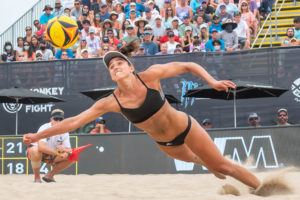
Yes, yes, the sheer volume is new, too. Gone is the country quota system, capping federations at four teams per event. You’ll see far more Americans, Brazilians and Germans, among other strong and deep federations, populating the lists now, as evidenced by the fact that there are four Americans in the top 10 alone — with another two to potentially emerge from the qualifier.
The American men, meanwhile, have only a single team in the top 10, one in which we have already become familiar: Chaim Schalk and Theo Brunner. They begin this season not in the country quotas, as they did in 2021, but as the second-ranked American team, behind only Tri Bourne and Trevor Crabb, who are sitting out of Tlaxcala to prepare for next week’s Elite 16 in Rosarito, Mexico.
Behind them, in the qualifier, are Troy Field and Chase Budinger, Andy Benesh and Nick Lucena, Taylor Crabb and Taylor Sander, Miles Evans and Logan Webber, who are not a new team — Webber is competing domestically with John Hyden — but need one another for international events, and Tim Brewster and I, who made the absurd climb from No. 34 on the reserve list and into the qualifier.
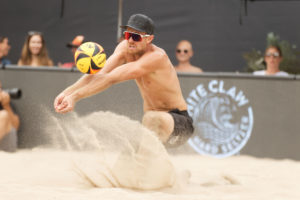
Points are still the sport’s most valuable currency. And it is points that will become so valuable for these new partnerships, especially that of, say, Brandie Wilkerson and Sophie Bukovec, Canada’s new No. 3 team.
After a decorated and successful career as perhaps the best defender in Canadian history, Heather Bansley officially announced her retirement. In need of a new partner, Wilkerson, not unlike Sam Schachter — more on him Wednesday! — turned to a player who was sort of in the game, sort of out, in Bukovec. She’d been training plenty, Bukovec, but didn’t compete in 2020 and played just three events in 2021, highlighted by a silver medal in a Sofia, Bulgaria one-star with Camille Saxton.
Now she’s partnered with Wilkerson, a 29-year-old who in 2018 was named the FIVB’s Best Blocker. And they’ll begin from the qualifier, alongside a number of decorated players who likewise turned to newer players with little points to their name. There’s the Czech Republic’s Barbora Hermannova, a two-time Olympian, and Marie-Sara Stochlova, who are the top seed in the qualifier. Argentinians and Tokyo Olympians Ana Gallay and Fernanda Pereyra are not new, but still: They are the No. 7 seed in Wednesday’s qualifier.
Italian Olympian Viktoria Orsi Toth has moved on from her longtime partner, Marta Mengegatti, to team up with her sister, LMU senior Reka Orsi Toth, beginning the familial team as No. 22 in the qualifier. Japanese veteran Megumi Murakami, a Tokyo Olympian, is one spot down, with Sakurako Fujii.
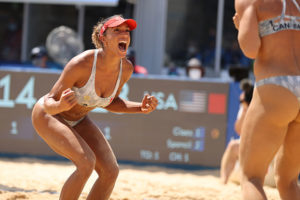
The men’s side is much of the same. Brazilian Bruno Oscar Schmidt, a gold medalist in the 2016 Rio Games and unquestionably the best player in the world in 2015 and 2016, is in the qualifier, partnered with 28-year-old blocker Saymon Barbosa. Chilean cousins Marco and Esteban Grimalt, whose torrid run to begin the Tokyo Olympic qualification process proved to be the fuel needed to get them in, are two spots down. One below them is Australia’s top team, Chris McHugh and Paul Burnett, who took gold in the Asian Championships, stunning Qatar’s Ahmed Tijan and Cherif Samba in the process. And one below them, in an absurdly talented cropping from seeds three through seven, is Renato Lima and Vitro Felipe, finalists in the Itapema four-star last November.
Switzerland’s Adrian Heidrich, a 2021 Olympian alongside the now-retired Mirco Gerson, is now partnered with young Leo Dillier, a 20-year-old with but five international events to his resume.
By now we know the bona fides of Taylor Crabb and Taylor Sander, who are, wild as it sounds, the No. 11 seed in the qualifier, the first time Crabb has been subjected to the gauntlet of a qualifier since the 2018 Vienna Major.
Directly below the Taylors are Argentinian brothers Nico and Tomas Capogrosso, the former of whom competed in Tokyo.
At No. 19 are Sam Schachter and Dan Dearing, a freaky athletic team — and a dangerous one. Schachter, one of the best defenders in the world, qualified for the 2016 Olympics in Rio and barely missed out on Tokyo with Sam Pedlow. Now he’s turned to Dearing, a 32-year-old coming off a seven-year hiatus from the game.
But at least Dearing competed some. That’s more than 17-year-old Latvian Kristians Fokertos can say. After playing in just two CEV youth tournaments — he finished second in 2020 and fourth in 2021 — Fokertos is now playing with Edgars Tocs, a fourth-place finisher in the Tokyo Olympics who began this event, unbelievably, on the reserve list.
It’s new, so much of this event, so much of this season.
But new is good.
New is exciting.
Nuevo es emocionante.